The short answer
Generative engine optimisation (GEO) is the work of making your business easy for AI tools such as ChatGPT, Gemini, Perplexity and Google AI Overviews to find, trust and recommend. It builds on SEO: AI crawlers need access, your business details must be clear and consistent, and your pages need direct answers worth quoting.
What is generative engine optimisation?
Generative engine optimisation, or GEO, is the practice of shaping your website and online presence so that AI tools recommend your business when people ask them for help. The term comes from a 2023 research paper by university researchers that studied how content could be made more visible in AI-written answers.
“Generative engines” are the tools that write an answer instead of showing a list of links: ChatGPT, Google Gemini, Perplexity, Microsoft Copilot, Claude and the AI Overviews at the top of many Google searches. When someone in Melbourne types “Who is the best electrician in Box Hill?” into one of these tools, it writes a short answer and usually names a few businesses. GEO is about being one of those names.
It matters because the answer often replaces the click. If the AI tool names your competitor, the customer may never see the search results where you rank.
How do AI tools choose which businesses to recommend?
Each tool works a little differently, but the basic pattern is the same.
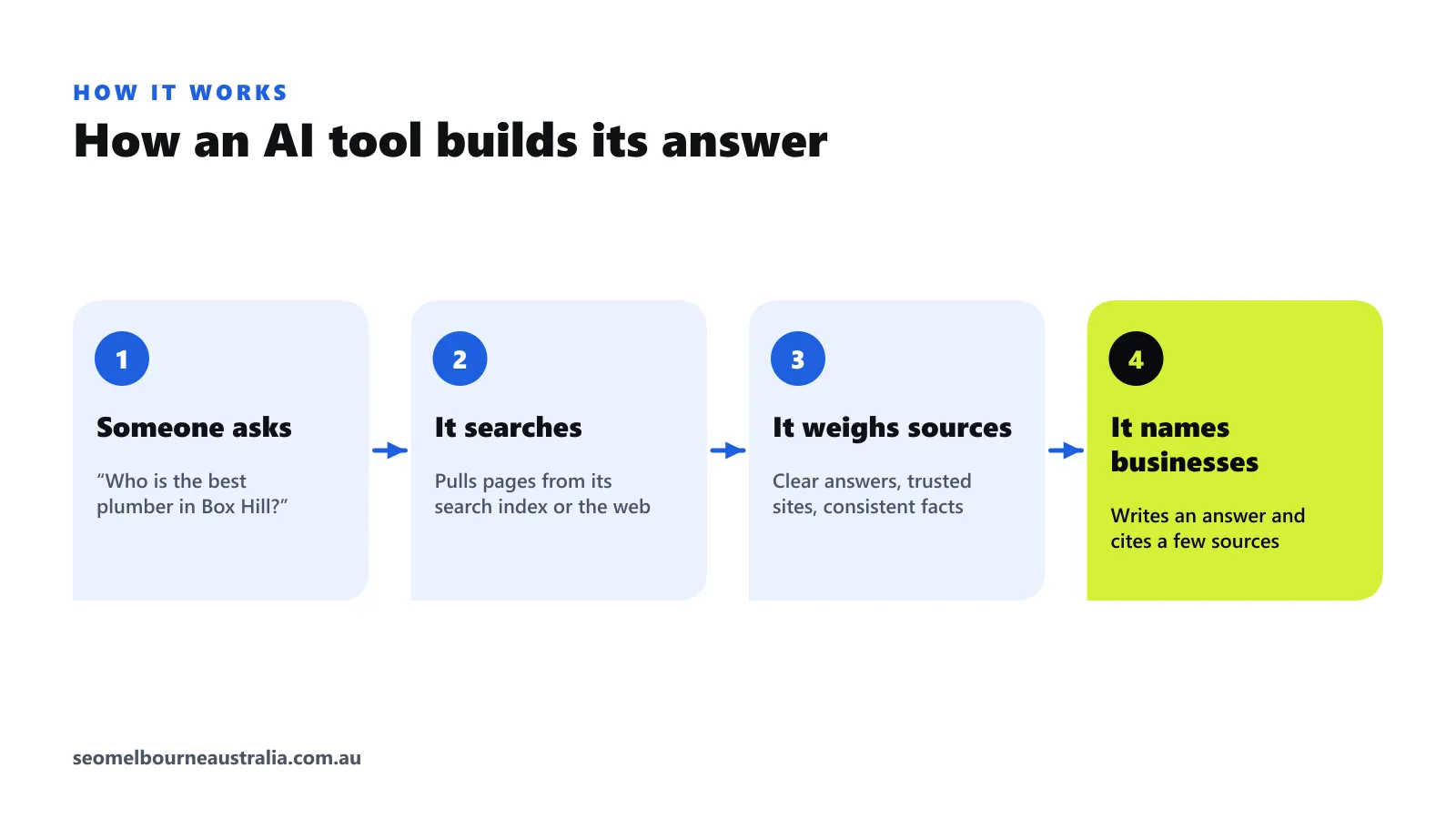
- Someone asks a question. Usually in plain English, often with a suburb or a need in it.
- The tool searches. ChatGPT search uses OpenAI’s own crawler and search partners, Gemini and AI Overviews draw on Google’s index, and Perplexity searches the web live.
- It weighs the sources. Pages that answer the question clearly, sites it considers trustworthy, and facts that agree across many sources are more likely to be used.
- It writes an answer and names businesses. It usually cites a handful of sources, and those links are where the clicks go.
Two things follow from this. First, if an AI crawler cannot reach your site, your pages cannot be used. Second, the tool is looking for agreement: your business name, location and services should say the same thing on your website, your Google Business Profile and every directory that lists you.
How is GEO different from SEO and AEO?
You will see three acronyms used together. They overlap, and the same work often helps all three.
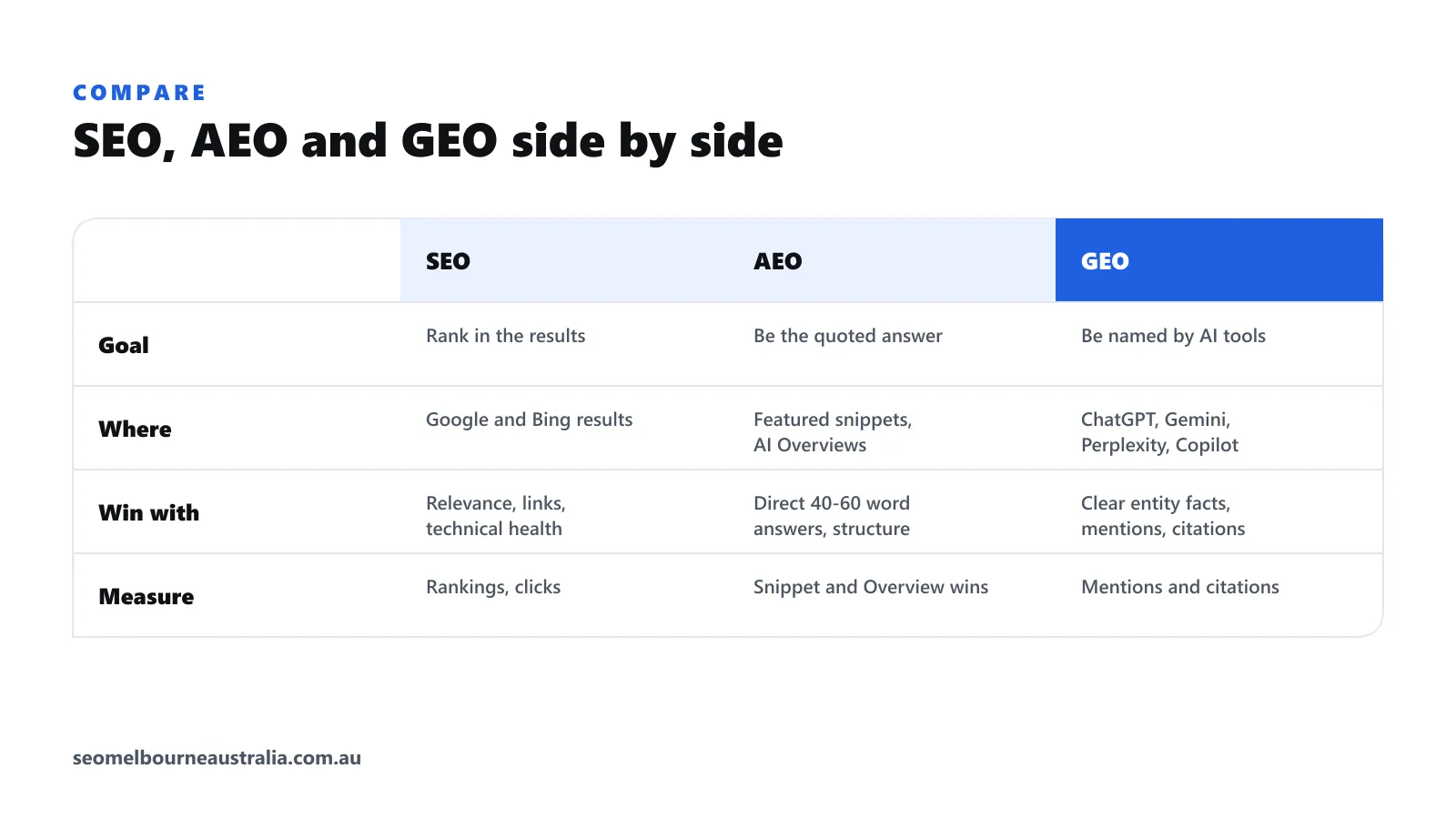
| SEO | AEO | GEO | |
|---|---|---|---|
| Goal | Rank in search results | Be the quoted answer | Be named by AI tools |
| Where | Google and Bing results | Featured snippets, AI Overviews | ChatGPT, Gemini, Perplexity, Copilot |
| Measure | Rankings and clicks | Snippet and Overview wins | Mentions and citations |
Search engine optimisation is still the foundation. Most AI tools rely on a search index to find pages, so a site that is slow, hard to crawl or thin on content is unlikely to be cited. Answer engine optimisation focuses on writing answers that Google can lift into featured snippets and AI Overviews. GEO adds the entity work: making sure AI tools know exactly who your business is, what it does and where.
Seven steps to get your business recommended by AI
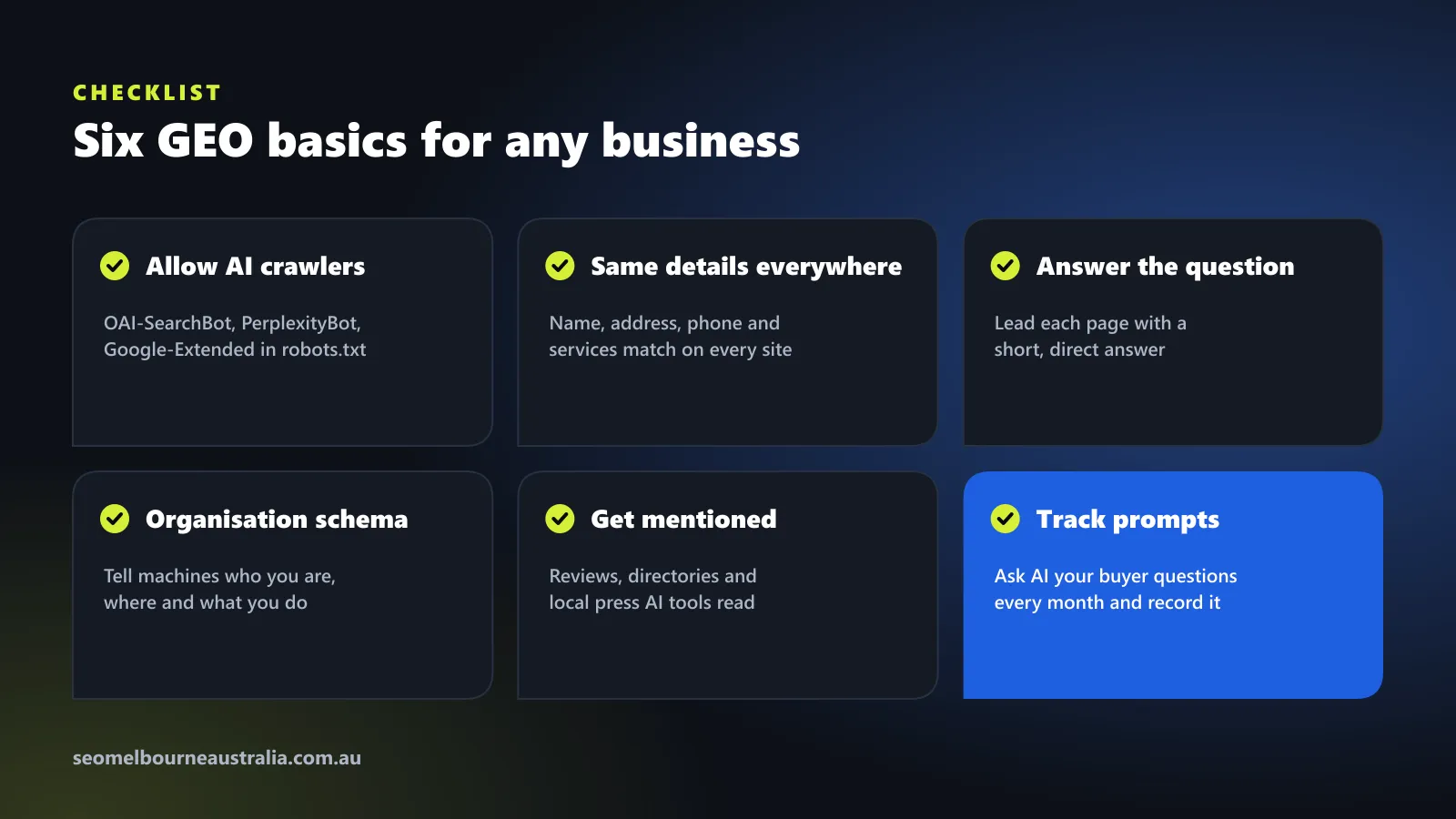
1. Let AI crawlers reach your site
Check your robots.txt file and any firewall or bot-protection settings. Crawlers to allow include OAI-SearchBot and ChatGPT-User (OpenAI), PerplexityBot (Perplexity), ClaudeBot (Anthropic), Bingbot (which feeds Copilot) and Googlebot. Google-Extended is a separate setting that controls whether your content is used for Google’s AI models. Blocking these by accident is one of the most common reasons a business never appears in AI answers. It is also one of the quickest things to fix, and pages with no internal links are just as hard for crawlers to reach, so check for orphan pages at the same time.
2. Be a clear, consistent entity
AI tools build a picture of your business from many sources. Use exactly the same business name, address, phone number and service list on your website, Google Business Profile, Apple Business Connect, Bing Places and directories. Add organisation or local business schema to your site so machines can read those details directly, and keep your About page specific: who you are, where you work and what you do.
3. Lead every page with a direct answer
AI tools quote content that answers the question in a few clear sentences. Start service pages and articles with a 40 to 60 word answer to the main question, then add detail. Write the way customers ask: “How much does a bathroom renovation cost in Melbourne?” is a better heading than “Our pricing philosophy”.
4. Cover the questions buyers actually ask
List the questions customers ask you on the phone, then make sure each one is answered somewhere on your site, in a service page, a FAQ or a guide like this one. Include the details that make an answer useful: suburbs you cover, price ranges you stand by, how long jobs take and what happens next.
5. Earn mentions on sites AI tools read
Reviews on Google, mentions in local news, listings in respected directories and articles on industry sites all help AI tools trust that your business is real and well regarded. Ask every happy customer for a review, and reply to the reviews you get.
6. Keep your facts fresh
Out-of-date hours, prices or services confuse AI tools as much as customers. Update your Google Business Profile and website at the same time whenever something changes.
7. Track your AI visibility every month
Write down ten to twenty questions a buyer in your area would ask, run them in ChatGPT, Gemini, Perplexity and Google each month, and record who gets named: you, a competitor or no one. Over time that list shows whether the work is moving the needle.
What does GEO look like for a local Melbourne business?
Take a plumber in Box Hill. A customer asks ChatGPT for “an emergency plumber near Box Hill who can come tonight”. To be named, the plumber needs a site the AI tool can crawl, a clear page about emergency plumbing in Box Hill and nearby suburbs that says what the business does after hours, a Google Business Profile with the same name, phone and hours, and reviews that mention emergency call-outs. None of that is exotic. It is good local SEO, written so a machine can read and repeat it. Our local SEO work covers most of it.
How do you measure GEO?
There is no single dashboard yet. A practical approach combines three things:
- A prompt log. The monthly list of buyer questions from step 7, with who was named each time.
- Referral traffic. Visits from chatgpt.com, perplexity.ai and similar sources show up in Google Analytics 4 as referrals.
- Leads. Ask new customers how they found you, and record “AI tool” as an option. Tracking calls and leads properly makes this much easier.
Where to start
If you only do three things this month, check your robots.txt for blocked AI crawlers, make your business details identical everywhere, and add a direct answer to the top of your most important service page. If you would rather we look for you, our free SEO and AI visibility audit runs your buyer questions in ChatGPT, Gemini, Perplexity and Google and shows who gets named, and our AI SEO service does the work to change it.
Frequently asked questions
What does GEO stand for?
GEO stands for generative engine optimisation. It means improving how often AI tools that write answers, such as ChatGPT, Gemini, Perplexity and Google AI Overviews, mention, cite and recommend your business.
Is GEO different from SEO?
GEO builds on SEO rather than replacing it. SEO helps you rank in search results; GEO helps AI tools understand who you are and choose you when they write an answer. Most AI tools pull from search indexes, so strong SEO is the base GEO needs.
How do I get my business recommended by ChatGPT?
Let OpenAI's search crawler reach your site, keep your name, address, phone and services identical everywhere, answer buyer questions directly on your pages, and earn reviews and mentions on sites AI tools read. Then ask ChatGPT your buyer questions each month to track progress.
How long does GEO take to work?
Technical fixes such as unblocking AI crawlers can matter within weeks, once tools recrawl your site. Building the mentions, reviews and content that make AI tools trust you usually takes months, much like SEO.
Can you guarantee my business will appear in AI answers?
No. AI answers change with each question, user and update, and nobody controls them. GEO improves your chances by making your business easier to find, understand and trust, and tracking shows whether it is working.

Jack is a Content Strategist at SEO Melbourne Australia. Jack plans the content and campaigns that bring Melbourne businesses calls and enquiries, and writes our guides on search, AI visibility and lead tracking. Meet the team