The short answer
Answer engine optimisation (AEO) is the practice of writing and structuring pages so search engines can lift your content straight into answers: featured snippets, People also ask boxes and Google AI Overviews. It means answering each question directly in 40 to 60 words, using clear headings, lists and tables, and keeping pages indexed and trusted.
What is answer engine optimisation?
Answer engine optimisation, or AEO, is the practice of shaping your content so search engines can use it as the answer, not just list it as a result. Instead of hoping someone scrolls and clicks, you write each page so Google can lift a clear, accurate answer from it.
“Answer engines” include Google’s AI Overviews, featured snippets and People also ask boxes, Bing’s answers, and voice assistants that read a single result aloud. All of them prefer the same thing: a page that answers the question directly, early and accurately.
AEO is part of good SEO. It does not replace links, technical health or useful content. It makes sure that when your page is good enough to rank, it is also easy to quote.
Where do answers appear in Google?
- AI Overviews. A written summary at the top of many searches, with links to the pages it drew from. This is where the click goes now for many informational searches.
- Featured snippets. A single quoted paragraph, list or table above the normal results, with your page linked.
- People also ask. Expandable related questions, each answered with a short extract from a page.
- Local and knowledge panels. Facts about a business pulled from its Google Business Profile and website.
How does Google choose the sources for AI Overviews?
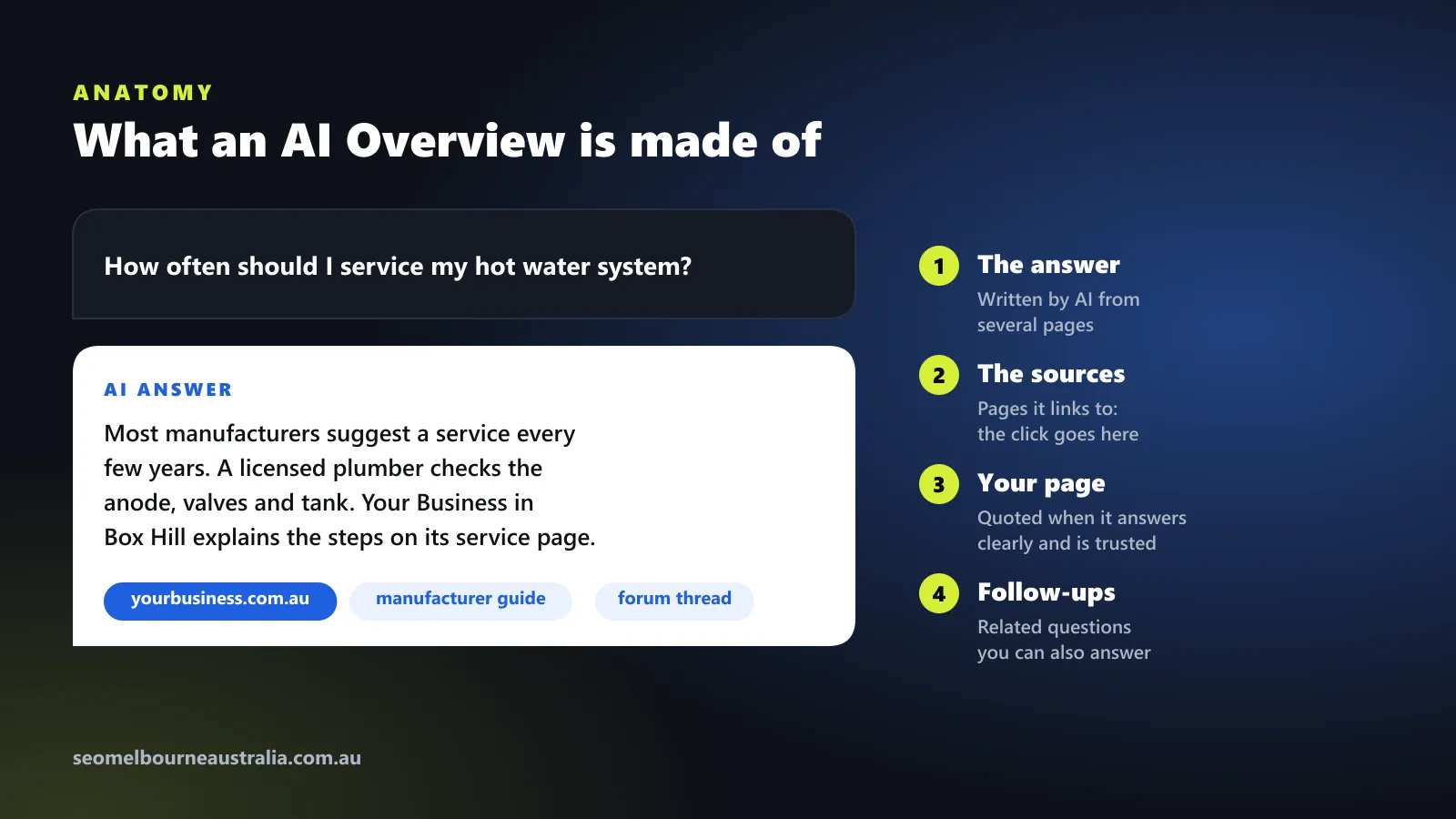
Google’s guidance for site owners is straightforward. To appear as a supporting link in AI Overviews, a page must be indexed and eligible to show with a snippet in Google Search. There is no special file or markup for AI features. The same signals that decide normal rankings, such as relevance, helpfulness, freshness and trust, decide which pages are used.
In practice, the pages that get cited tend to share a few traits:
- They answer the exact question, in plain words, near the top.
- They add detail that is genuinely useful: steps, numbers, examples, local specifics.
- They are well structured, so the answer is easy to find and extract.
- They come from sites with a clear identity and a track record on the topic.
How do you write a page Google can quote?
The simplest pattern is answer first, detail second.
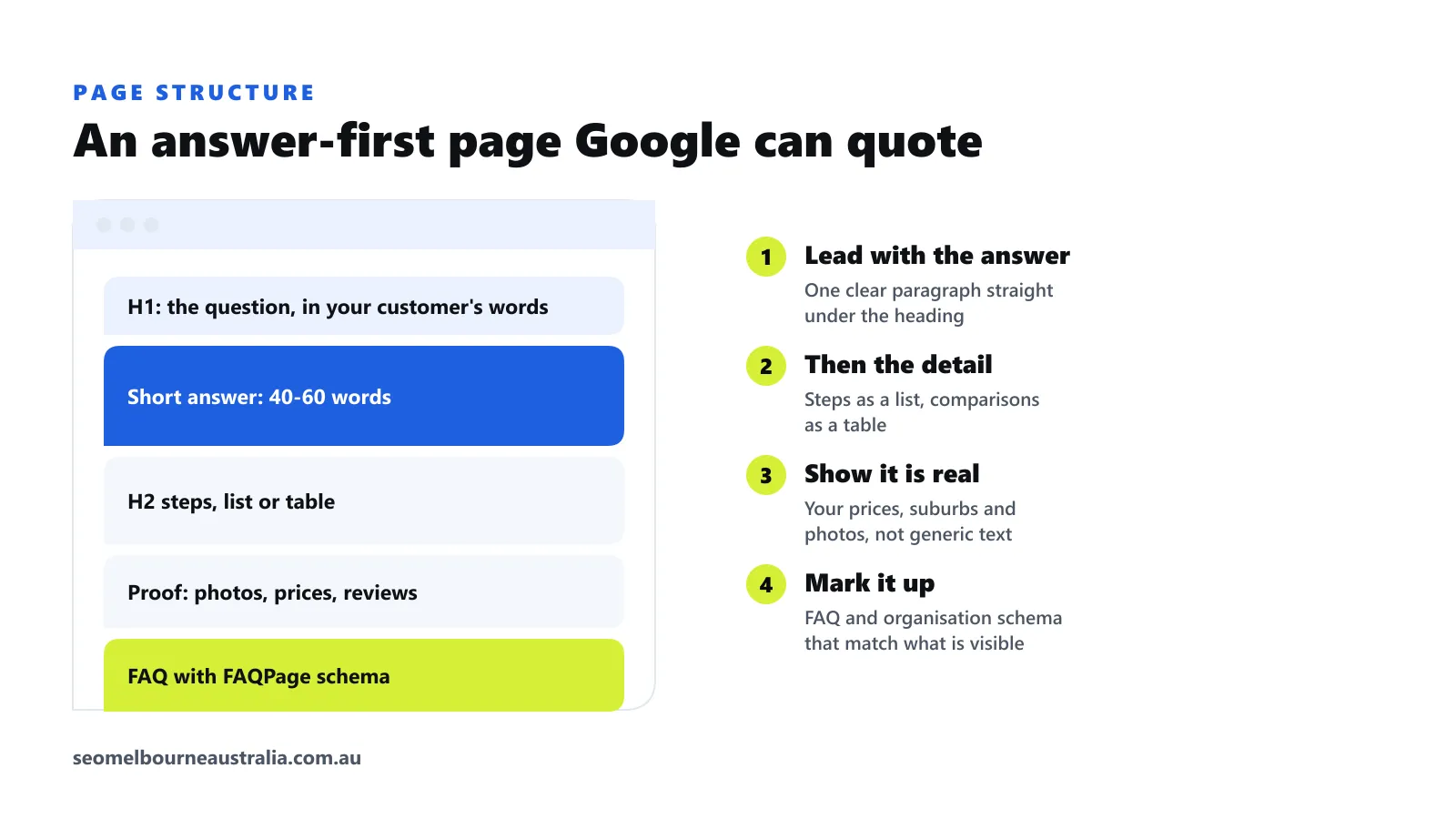
- Use the question as the heading. Write it the way your customer would say it: “How often should I service my hot water system?”
- Answer it in 40 to 60 words straight underneath. One complete paragraph that would make sense on its own if it were the only thing someone read.
- Then give the detail. Steps as a numbered list, comparisons as a table, costs as ranges you stand by.
- Show it is real. Your suburbs, photos of your work, your prices and reviews make a page more trustworthy than generic text.
- Finish with related questions. A short FAQ covers the follow-ups people ask next.
Which answer format should you use?
Match the format to the type of question. Google tends to show the format that best fits the search.
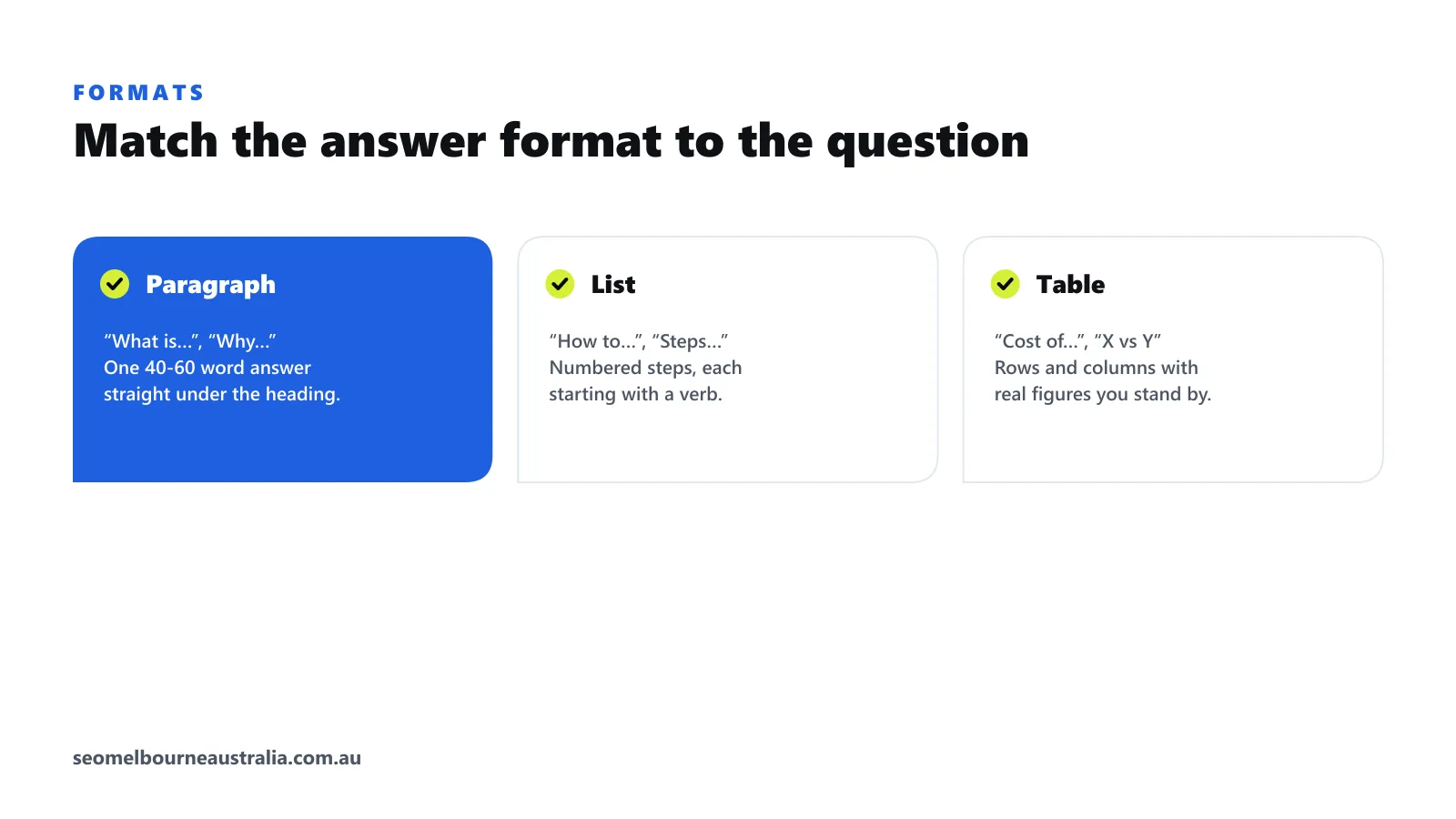
| Question type | Best format | Example |
|---|---|---|
| What is, why | One 40-60 word paragraph | “What is a hot water anode?” |
| How to, steps | Numbered list, each step starting with a verb | “How to reset a safety switch” |
| Cost, comparison | Table with real figures | “Gas vs electric hot water cost” |
Does schema markup help AEO?
Schema markup will not make a weak page quotable, but it helps machines read a good one. Organisation or local business schema confirms who you are. FAQ markup describes your questions and answers, as long as it matches the visible text. Breadcrumb markup shows where a page sits on your site. Google limited FAQ rich results to well-known government and health sites in 2023, so do not expect the expandable FAQ to show for a business site; the value now is clarity rather than a visual feature.
Common AEO mistakes
- Burying the answer. Three paragraphs of introduction before the point. Put the answer first.
- Vague answers. “It depends” with no ranges or examples gives Google nothing to quote.
- One page, many questions, no headings. Break content into clear question headings.
- Blocking crawlers or snippets. A “nosnippet” tag or a blocked page cannot be used in answers.
- Copying the same text across pages. Duplicate answers compete with each other.
How do you measure AEO?
Google Search Console includes AI Overview clicks and impressions in your normal web search figures, without a separate report. Track the pages that target questions: watch their impressions and clicks, search the questions yourself each month and note when your page is cited, and record enquiries that mention the article. Our guide to tracking calls and leads from SEO shows how to connect those visits to real enquiries.
AEO, GEO and SEO work together
AEO wins you the answer box and the AI Overview citation. Generative engine optimisation helps ChatGPT, Gemini and Perplexity name your business. Both stand on technical SEO and quality content. If you want to see where you stand, our free SEO and AI visibility audit checks which of your pages are cited and which questions your competitors are winning, and our AI SEO service does the work to change it.
Frequently asked questions
What is answer engine optimisation?
Answer engine optimisation (AEO) is writing and structuring content so search engines and AI assistants can use it as a direct answer, for example in featured snippets, People also ask boxes, Google AI Overviews and voice assistants.
How do I get my website into Google AI Overviews?
Google says a page must be indexed and eligible to show with a snippet in normal search to be used in AI Overviews, and there is no special markup for it. Answer the question clearly near the top of the page, back it up with useful detail, and keep the page crawlable and fast.
Is AEO the same as GEO?
They overlap. AEO focuses on being the quoted answer in search features such as AI Overviews and featured snippets. GEO focuses on being named by AI chat tools such as ChatGPT and Perplexity. The same clear, answer-first content helps both.
Does FAQ schema still help?
Google now shows FAQ rich results mainly for well-known government and health sites, so most businesses will not see the expandable FAQ in results. FAQ markup still describes your questions and answers in a format machines read easily, as long as it matches what is visible on the page.
How do I know if my page is in an AI Overview?
Search Console counts AI Overview clicks and impressions inside normal web search totals, without a separate filter. The practical check is to search your key questions in Google regularly, note whether your page is cited, and watch for changes in clicks to those pages.

Jack is a Content Strategist at SEO Melbourne Australia. Jack plans the content and campaigns that bring Melbourne businesses calls and enquiries, and writes our guides on search, AI visibility and lead tracking. Meet the team